
Asset management in the Indian Metro Rail sector has evolved rapidly over the past two decades, driven by the need for efficiency, safety, and long-term sustainability of high-value infrastructure. However, the absence of a unified standard for asset codification and functional location structures continues to be a major gap. In most Indian metro tenders, suppliers or system integrators are not held contractually responsible for delivering codified asset data compliant with a predefined standard. This leads to fragmented databases, incompatible maintenance systems, and significant inefficiencies in lifecycle management. The article examines the state of asset management practices across major Indian metro projects, compares them with international standards such as ISO 55000 and PAS 55, and proposes a framework for enforcing codification standards contractually. It concludes by recommending that asset and functional location hierarchies be defined upfront by the employer and made a mandatory supplier deliverable, supported by audit and verification mechanisms.
1. Introduction
The Indian metro rail network has expanded at an unprecedented pace, covering over 900 km of operational corridors with another 1,000 km under construction. Each new corridor involves complex civil, systems, and rolling stock packages awarded to multiple suppliers. While the engineering and construction aspects have matured, the domain of Asset management – a critical component for operations and maintenance (O&M) excellence has lagged behind in standardisation.
Asset management in metro rail refers to the systematic process of managing physical assets (such as tracks, signalling, rolling stock, power supply, and stations) throughout their lifecycle, from design and acquisition to operation, maintenance, and disposal. It enables reliability, safety, and cost optimisation by ensuring that assets perform as intended. Despite this importance, the approach to asset management in Indian metro tenders remains fragmented and supplier-driven rather than system-driven.
2. Evolution of Asset Management in Indian Metro Projects
When the Delhi Metro Rail Corporation (DMRC) began its operations in 2002, it set new benchmarks for project execution and operations. However, asset management practices were largely manual in early phases, based on traditional railway-style registers. Over time, other projects—such as Bengaluru, Hyderabad, Chennai, Mumbai, and Pune metros – adopted digital systems like IBM Maximo, SAP EAM, and Infor EAM.
Despite this adoption, each metro organisation developed its own unique codification logic for assets and functional locations. There has been no centralised guideline from the Ministry of Housing and Urban Affairs (MoHUA) or Metro Rail Policy (2017) on how assets must be hierarchically structured. As a result, system integrators and contractors often define codes independently to meet their own project-level requirements.
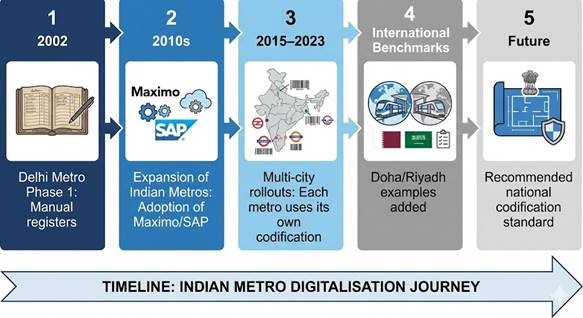
This lack of uniformity leads to several problems: difficulty in integrating multiple systems, challenges in comparing maintenance KPIs across corridors, and duplication of asset data. Moreover, when metros seek to implement reliability-centred maintenance (RCM) or condition-based monitoring (CBM), the inconsistency in asset codes severely limits automation.
3. Understanding Asset and Functional Location Codification
An asset codification system assigns a unique identifier to every physical component or system within the metro infrastructure. Similarly, functional location codification represents where an asset is functionally situated within the overall network. Together, these form the backbone of any Enterprise Asset Management (EAM) system.
Globally, ISO 14224, ISO 55000, and BS EN 81346 provide guiding principles for defining such structures. A well-defined hierarchy ensures traceability, uniform reporting, and integration with maintenance, finance, and inventory systems.
However, in most Indian metro tenders, the tender documents do not specify the codification methodology. Instead, they simply require the supplier to “provide asset data in a format acceptable to the employer.” This vague clause results in suppliers using incompatible conventions—some based on equipment tag numbers, others on drawing identifiers—making consolidation impossible.
4. Current Challenges and Gaps
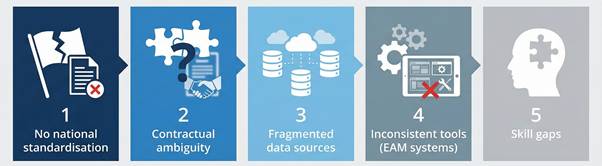
4.1 Absence of National Standardisation
Unlike the UK, where the Office of Rail and Road (ORR) and Network Rail prescribe asset information standards, India has no single guideline for metro rail asset codification. Each project evolves its own approach.
4.2 Lack of Contractual Clarity
Tender specifications rarely define whether the responsibility for asset and functional location codification lies with the system supplier, the operator, or the project management consultant (PMC). This results in “grey zones” where asset data ownership is disputed at the end of the Defects Liability Period (DLP).
4.3 Fragmented Data Sources
Multiple contractors maintain separate asset registers for signalling, power supply, and rolling stock. Integrating them into a single EAM environment post-commissioning requires extensive rework.
4.4 Inconsistent Use of Tools
Some metros use IBM Maximo, others adopt SAP EAM or custom-built platforms. Since codification differs, data migration becomes a major cost component.
4.5 Skills and Awareness Gap
O&M personnel often receive incomplete training on asset hierarchy principles, leading to inconsistent asset data entry and poor utilisation of EAM capabilities.
5. Case Observations from Indian Metro Projects
Based on field experience from brownfield and greenfield metro implementations, several patterns emerge:
Delhi Metro: Initially relied on equipment lists from contractors, later migrated to a more structured Maximo environment. However, early codification inconsistencies persist.
Hyderabad Metro: Implemented EAM(Maximo) from the start, but contractors were not aligned on codification. Post-commissioning reclassification took over six months.
Doha and Riyadh Metros (international references): These projects adopted strict asset hierarchy templates provided in the tender. Every supplier delivered data as per ISO 14224 and BS EN 81346 structure, significantly easing system integration.
Mumbai Metro Line 3 and 7: Observed to have independent asset registers prepared by contractors; harmonisation required dedicated effort by the operator’s IT and O&M teams.
These observations highlight the need for a standardised national or contractual approach that enforces codification consistency from design to handover.
6. Global Best Practices in Asset Management
Globally, mature metro systems such as London Underground, Singapore MRT, and Hong Kong MTR follow ISO 55000-compliant asset management frameworks. These specify not only lifecycle principles but also the structure of asset data.
The UK’s PAS 55 (Publicly Available Specification 55) served as the precursor to ISO 55000 and emphasised information management as the foundation of asset governance. Similarly, the European BS EN 81346 standard defines reference designations for systems and plants, ensuring that every asset and functional location code conveys meaningful information about its type and hierarchy.
“Effective asset management relies not only on data but on the structure and consistency of that data.” (1)
By adopting these principles contractually, Indian metros can eliminate redundancy and establish transparency in O&M processes.
7. The Role of Standards (ISO 55000, PAS 55, and Others)
The ISO 55000 family defines asset management as “the coordinated activity of an organisation to realise value from assets.” (2) It prescribes that asset information must be accurate, traceable, and aligned with organisational objectives.
ISO 55002 further explains that “information requirements should be defined at the design stage and communicated to suppliers through contractual obligations.” (3)
Similarly, the BS EN 81346 standard proposes a reference designation system (RDS) to organise assets functionally, locationally, and product-wise. Applying such standards in tendering ensures that contractors provide codified data compatible with the operator’s EAM platform.
In essence, the responsibility for preparing the asset and functional location codified file must rest with the supplier, but the structure must be predefined in the contract, ensuring both accountability and uniformity.
8. Recommendations for Standardised Tendering and Supplier Responsibility
8.1 Development of a National Metro Asset Codification Standard
The Ministry of Housing and Urban Affairs (MoHUA), in coordination with the Indian Metro Rail organisations, should publish a National Metro Asset Codification Framework (NMACF) aligned with ISO 55000 and EN 81346. This would provide guidelines on numbering systems, asset hierarchy levels, and naming conventions.
8.2 Tender Document Integration
Every metro tender should include:
- A standard codification template in the Employer’s Requirements.
- Clauses defining that each supplier must submit the asset codified file and functional location hierarchy before the Testing & Commissioning stage.
- A requirement for digital submission compatible with the chosen EAM (Maximo/SAP/Infor).
8.3 Supplier Accountability
System integrators must be contractually obligated to:
- Tag all equipment physically with its asset code.
- Deliver as-built data in the defined codified format.
- Update the codified file for any design or site change during execution.
This ensures that the complete asset dataset is ready for migration to the operator’s system immediately after commissioning.
8.4 Role of the PMC and Operator
The Project Management Consultant should verify and audit codification compliance. The operator must participate from the design stage to ensure the codified structure aligns with O&M workflows.
8.5 Lifecycle Integration
A unified codification system enables seamless integration between asset management, maintenance management, inventory, and financial systems, improving decision-making and cost control.
9. Benefits of Standardised Codification
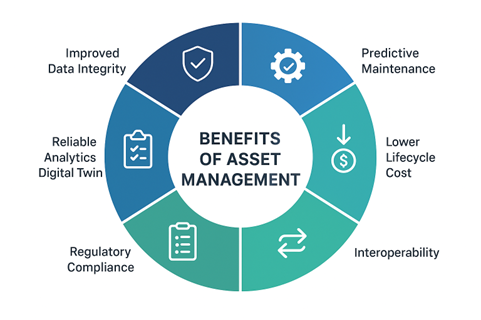
- Enhanced Data Integrity: Ensures accuracy and uniformity across disciplines.
- Ease of Maintenance: Facilitates condition monitoring and predictive maintenance.
- Regulatory Compliance: Supports safety audits and risk traceability.
- Reduced Lifecycle Cost: Minimises duplication and rework during migration.
- Interoperability: Allows multiple lines or metros to compare KPIs consistently.
- Asset Performance Analytics: Enables advanced analytics and digital twin applications.
10. Conclusion(s)
The rapid growth of India’s metro network has brought operational complexity that demands a robust asset management foundation. Yet, the absence of a national or contractual standard for asset and functional location codification remains a significant oversight. Without uniform codification, even the most advanced EAM systems cannot deliver full value.
Therefore, the time has come for policymakers, project implementers, and operators to mandate codification standards in every metro contract. The employer must define the structure; the supplier must populate and deliver the codified asset file; and the PMC must verify compliance. Only through such clarity can Indian metros transition from fragmented data silos to intelligent, interoperable asset ecosystems aligned with global best practices.
A well-governed, standardised asset management regime is not just a technical necessity—it is a strategic imperative for sustainable urban mobility in India.
References
(1) Institute of Asset Management (IAM), An Overview of Asset Management Principles, 2014.
(2) ISO 55000:2014, Asset Management — Overview, Principles and Terminology.
(3) ISO 55002:2018, Asset Management — Management Systems — Guidelines for the Application of ISO 55001.
(4) BS EN 81346-1:2022, Industrial Systems, Installations and Equipment and Industrial Products — Structuring Principles and Reference Designations.
(5) PAS 55-1:2008, Specification for the Optimised Management of Physical Infrastructure Assets, British Standards Institution.
(6) Ministry of Housing and Urban Affairs, Metro Rail Policy, Government of India, 2017.
(7) Delhi Metro Rail Corporation, Project Implementation Reports, 2022.
(8) Network Rail, Asset Information Strategy — UK Rail Standard NR/L2/INI/02009, 2016.
(9) World Bank, Urban Transport Sector Note on Asset Management Practices, 2020.
Publised in RAIL BUSINESS
Railway Budget Highlights : New Corridors at Last
Volume 16, Issue 75, MARCH 2026 ISSN No. 0976-254X | Page 33
www.rollingcarssociety.com