
If you look at a railway map, the operation seems simple: trains travel from Station A to Station C, and you just need someone to drive them. But behind every published schedule is a complex mathematical puzzle. Calculating the required number of train operators isn’t just about total driving hours—it requires factoring in turnaround times, peak vehicle requirements, and the inevitable “shrinkage” of the human workforce.
Whether you are running a single metro line or a complex mixed-fleet operation with short and long loops, here is how transit planners actually do the math.
The Core Variables
To build our scheduling equations, we first define our operational constants:
-
Stations: A, B, C
-
Travel Time (T): The time it takes to travel between terminal stations.
-
Turnaround Time (R): The layover time required to switch cabs and prep the train for the return journey.
-
Cycle Time (C_total): The total time for a train to complete one full round trip.
-
Headway (H): The scheduled time gap between train departures.
-
Productive Time (P): The actual hours a driver spends driving per shift (excluding mandatory breaks).
Scenario 1: The Standard Loop
Let’s look at a baseline scenario using random data. We have a single line running from Station A to Station C, with a stop at Station B in the middle.
The Route Data:
- Travel Time (T): Station A to Station C takes 50 minutes.
- Turnaround Time (R): 10 minutes at both terminal ends.
- Headway (H): A train departs every 12 minutes.
- Operating Day: 18 hours per day.
- Productive Time (P): Operators drive exactly 5.5 hours per shift.
Step 1: Calculate Cycle Time
First, how long does one full round trip take?
C_total = (T_outbound + R_destination) + (T_inbound + R_origin)
C_total = (50 + 10) + (50 + 10) = 120 minutes
Step 2: Calculate Peak Active Operators
To maintain a 12-minute headway on a 120-minute cycle, how many trains (and therefore drivers) must be active simultaneously?
Active Operators = C_total / Headway = 120 / 12 = 10 operators
Step 3: Calculate the Roster Headcount
Those 10 active trains run for 18 hours a day, generating 180 total daily driving hours.
Daily Shifts = 180 (total hours ) / 5.5 (productive hours) = 32.7 (Rounded to 33 shifts)
Assuming a 5-day work week and a standard 20% shrinkage buffer (for sick days, holidays, and training), the math dictates:
Weekly shifts: 33 × 7 days = 231 shifts.

Base headcount: 231 / 5 = 46.2 operators.

Final Roster: 46.2 + 46.2 X 20% = 55.4
You need 56 operators on payroll to reliably run this simple A-to-C line.
Scenario 2: The Mixed Fleet (Short Loop vs. Full Loop)
Real transit systems are rarely that simple. Often, passenger demand is heavier in the city center (Station A to Station B) and drops off in the suburbs (Station B to Station C). To optimize operations, you split the fleet. You run Train Type 1 on the Full Loop (A -> C) and Train Type 2 on a Short Loop (A -> B).
Here is how the math splits.
The Full Loop (Type 1):
- Route: Station A to Station C
- Cycle Time (C_total): 120 minutes
- Headway (H): 15 minutes (less frequent for the suburbs)
Peak Active: 120/ 15 = 8 active operators
The Short Loop (Type 2):
- Route: Station A to Station B
- Cycle Time (C_total): 60 minutes
- Headway (H): 10 minutes (high frequency for city center)
Peak Active: 60/ 10 = 6 active operators
The Certification Catch
At peak times, you need 14 active operators (8 + 6) on the tracks. However, the final payroll headcount depends entirely on how your crew is certified.
Case A: Cross-Trained Operators (Universal Fleet)
If every driver is certified to operate both Train Type 1 and Train Type 2, you pool the driving hours together. You can seamlessly assign a driver to do two Short Loops in the morning and one Full Loop in the afternoon within their 5.5 hours of productive time. This shared pool is highly efficient and minimizes wasted paid time.
Case B: Type-Restricted Operators (Siloed Rosters)
If Train Type 1 is a heavy electric commuter train and Train Type 2 is a light rail vehicle, your operators likely cannot cross over without specialized training.
This forces you to run two mathematically independent rosters.
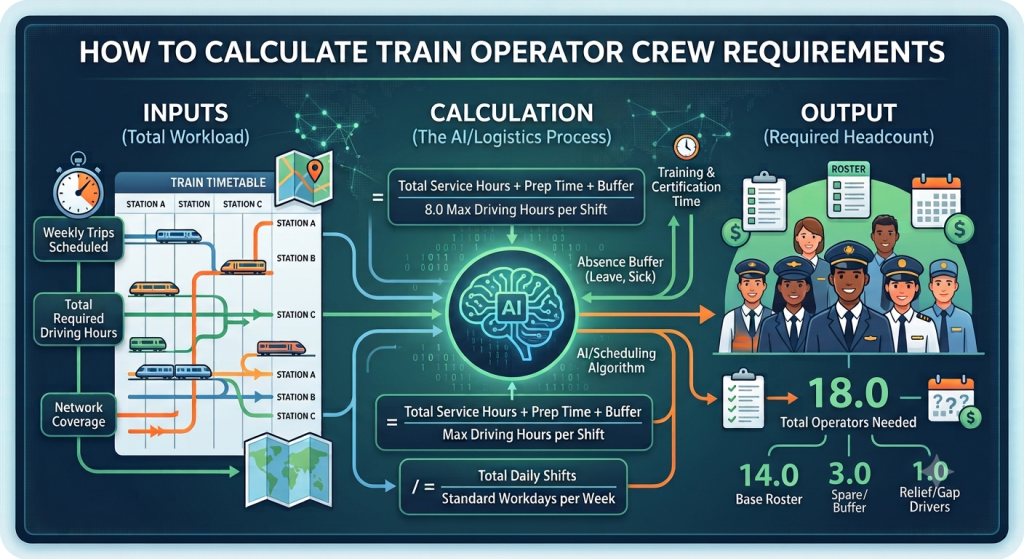
The golden rule of crew scheduling?
The more segmented your routes and train types become, the more operators you need to hire just to cover the math.