

SUNIT MITRA, PMP®, SAFe®
Metro Rail Planning & Resource Manager | Timetable & Roster Strategy | Workforce Optimization | PMP®, SAFe®, ACP® | Cost & Schedule Control | Project & program Controls | Agile & Lean Delivery | Open to Global Roles.
March 30, 2026
One of the most critical — and consistently underestimated — failure modes in metro operations is the cascade that originates from a single disruption and propagates through interconnected roster linkages until multiple services and staff positions are simultaneously compromised.
This is not simply “one problem causing another.” The defining characteristic is speed and non-linearity. The cascade accelerates faster than manual intervention can contain it.
Why metro operations are uniquely vulnerable
Rail and metro systems are tightly coupled environments. Staff duties are chained—a train driver/train attendant completing the train A often proceeds directly to Train B as a linked duty, with rest periods, meal breaks, and sign-off times calculated to the minute. Stations carry minimum staffing obligations governed by safety cases and industrial agreements. Trains operate on fixed paths and timetables where a 4-minute delay compounds at every downstream station.
The operational buffer between steady state and systemic failure is narrow by design.
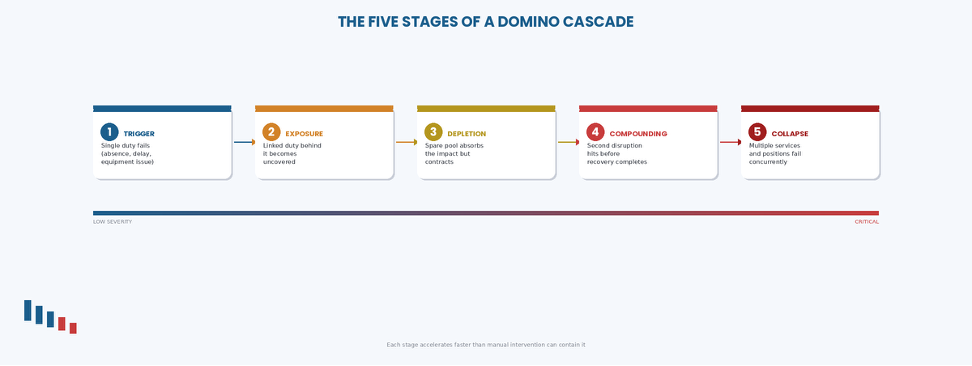
1. A single duty fails—absence, delay, or equipment issue
2. The linked duty immediately behind it becomes uncovered
3. The spare pool absorbs the impact but contracts
4. A second disruption occurs before recovery is complete
5. Multiple services and positions fail concurrently
Three structural amplifiers
Most roster managers understand the basic cascade. What distinguishes expert practitioners is recognising the conditions within the roster design itself that accelerate it:

→ Low spare ratio. When the relief pool sits below 10–12% of scheduled duties, the first domino has no safe landing. Each cover deployment depletes a finite buffer.
→ Tight rest period engineering. Rosters optimized aggressively for cost—minimum rest, back-to-back shifts, split duties—carry no temporal slack. A 20-minute delay can push a driver past their maximum hours threshold, rendering them legally unavailable regardless of willingness.
→ Qualification bottlenecks. In multi-line systems, drivers are often certified only on specific rolling stock or routes. When the cascade reaches a duty requiring a rare qualification, the eligible cover pool can collapse to two or three individuals across the entire network.
What elite roster designers do differently
The best practitioners build domino resistance into the roster at the design stage—not as a reactive afterthought.
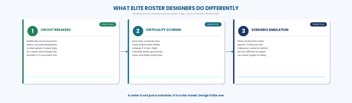
→ Circuit breakers. Deliberate structural points where cascade propagation is interrupted. A spare duty positioned mid-shift at a major interchange hub can absorb two or three concurrent disruptions before the chain reaches further linkage sequences.
→ Criticality scoring. Each duty is scored by the number of downstream duties that collapse if it fails. High-criticality duties receive priority cover planning and are never linked to extended chains without buffer.
→ Scenario simulation. Stress-testing the roster against 3-absence and 5-absence scenarios before it goes live. A roster that appears efficient on paper can be catastrophically fragile under real-world conditions.
A roster is not just a schedule. It is a risk model. It should be designed as one.
#MetroOperations #RailwayRostering #OperationalResilience #TransportPlanning #WorkforceManagement #RailOps #RosterDesign