In modern metro systems, Key Performance Indicators (KPIs) are the backbone of performance measurement and service quality evaluation. They determine not only how efficiently a metro system is being operated, but also how well passenger expectations are met. Among the most important considerations is how a “trip” is defined for KPI purposes.
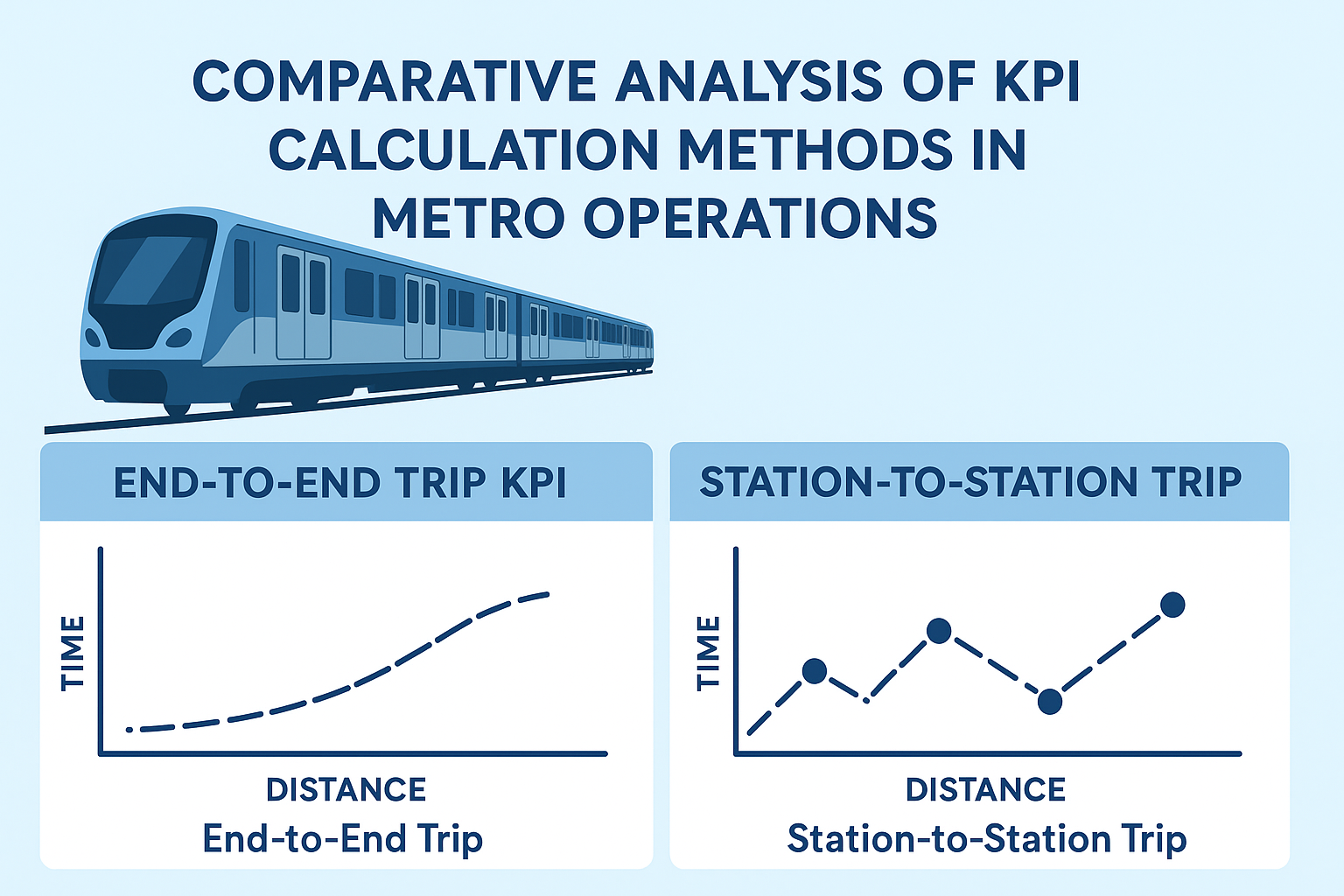
This article provides a comparative analysis of KPI calculation methods, focusing on end-to-end trip-based KPI measurement and station-to-station trip-based KPI measurement. By exploring both, metro operators and authorities can choose the most effective way to balance contractual compliance with passenger experience
Why Trip Definitions Matter in Metro KPI Measurement
In metro rail operations, a Trip is the fundamental building block of KPI measurement. It represents the unit against which service reliability, punctuality, and availability are calculated. However, the scope of a trip can vary:
-
End-to-End Trip: A complete journey from the origin station (or depot) to the terminal station.
-
Station-to-Station Trip: Each segment of the journey between consecutive stations, considered individually.
The difference between these two definitions can significantly alter reported performance levels.
Key Supporting Definitions in Metro Operations
Before comparing KPI methods, it is important to standardize the associated operational terms:
-
Passenger Service Time: The window starting 15 minutes before the first train until 5 minutes after the last train departs, when all passenger-facing systems must remain available.
-
Operation Time: The complete system operating window, covering both passenger and non-passenger train movements.
-
Dwell Time: The time a train spends at a platform.
-
Minimal Dwell – Minimum technical time for safe door operation.
-
Nominal Dwell – Planned dwell time in the reference timetable.
-
Maximum Dwell – Longest permissible dwell to maintain headway.
-
-
Cancelled Trip Criteria: A scheduled trip is considered cancelled if:
-
Minimal dwell not achieved.
-
Fewer than 50% of doors open per car.
-
A scheduled station is skipped.
-
Delay exceeds twice the scheduled headway.
-
-
Delay Definition: A train is delayed if arrival at the end station exceeds the permissible margin defined by ATS-calculated slow speed + minimal dwell compared to high-acceleration run time.
-
Force Majeure: External natural or manmade events beyond operator control (e.g., earthquakes, floods, terrorism, war, or electricity supply failures from the external grid).
Method 1: End-to-End Trip-Based KPI Calculation
Definition
A trip is counted only when a train completes its entire scheduled journey from the origin to the terminal station.
Advantages
-
Simple to calculate and report.
-
Aligns with passenger perception of a complete journey.
-
Ideal for contract-level performance reporting.
Limitations
-
Masks localized failures.
-
A skipped station may not register as a cancelled trip.
-
Provides limited insight into operational bottlenecks.
Method 2: Station-to-Station Trip-Based KPI Calculation
Definition
Each journey between two consecutive stations is considered a separate trip. A 10-station corridor generates 9 measurable trips in one direction.
Advantages
-
Highly granular, capturing local delays and skips.
-
Better reflects passenger experience at each station.
-
Provides actionable operational data (e.g., dwell compliance, door operation issues).
Limitations
-
Significantly higher reporting volume.
-
More complex data processing and KPI dashboards required.
-
May inflate “cancelled trip” numbers if disruptions are localized.
Real-World Metro Examples
Delhi Metro (India)
Delhi Metro primarily uses end-to-end trip measurement for its service reliability KPI. However, station-level dwell time monitoring is used internally to identify congestion hotspots (e.g., Rajiv Chowk, Kashmere Gate). This hybrid use ensures contractual compliance while also tracking passenger experience in high-traffic nodes.
Doha Metro (Qatar)
The Doha Metro applies a station-to-station KPI regime as part of its performance-driven contract with Qatar Rail. This ensures that even a single skipped station or failed door operation counts toward service penalties. Given its fully automated system, granular KPIs are vital to maintain world-class service levels.
Riyadh Metro (Saudi Arabia)
Riyadh Metro has adopted a blended approach. End-to-end trips are the basis for operator availability KPIs, but station-to-station monitoring is built into the Operations Control Centre dashboards. This allows the regulator (RDA) to monitor localized failures while keeping high-level KPIs consistent for benchmarking across lines.
Comparative Summary: End-to-End vs. Station-to-Station KPI
| Aspect | End-to-End Trip KPI | Station-to-Station Trip KPI |
|---|---|---|
| Granularity | Low – entire journey | High – per station segment |
| Visibility of Issues | Partial | Full |
| Passenger Experience Reflection | Moderate | Strong |
| Ease of Reporting | High | Moderate/Low |
| Operational Insights | Limited | Detailed |
| Best Use Case | Contract compliance, benchmarking | Operational monitoring, diagnostics |
Hybrid Approach: The Best of Both Worlds
In practice, many modern metro contracts adopt a hybrid KPI regime:
-
Primary KPI based on end-to-end trips, ensuring contract simplicity and comparability.
-
Secondary KPI based on station-to-station trips, providing granular insights into daily operations and passenger impact.
This ensures that while operators meet their contractual obligations, regulators and authorities also have visibility into micro-level service quality.
Conclusion
Choosing the right KPI calculation method in metro operations is not just about reporting numbers – it directly influences how service quality is perceived and managed.
-
End-to-End Trip KPIs offer clarity, simplicity, and a high-level view.
-
Station-to-Station KPIs provide depth, accuracy, and actionable insights.
A blended approach, as seen in Delhi, Doha, and Riyadh Metro systems, is increasingly the global best practice. It allows operators to balance accountability, passenger satisfaction, and operational improvement, ensuring that KPI reporting is both fair and impactful.